BitIncs.com Blog
1920s / 2020s?
By Todd Rasmussen • August 16, 2026
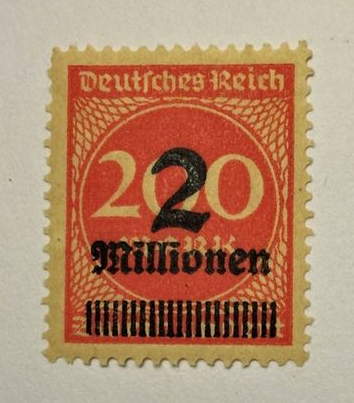
Back in the 1970s, long before the creation of Bitcoin, I came across a Weimar Republic postage stamp originally valued at 200 marks that had 2 million marks printed on it. I found out it came from Germany during the hyperinflation of the Weimar Republic. As Germany's currency lost purchasing power, 200 marks became practically meaningless. A 200-mark stamp became a 2 million mark stamp just by printing “2 Millionen” on it.
What had happened? The question led me to the history of the Weimar Republic and eventually to a much larger question: What happens to ordinary people when the money they depend upon fails to hold value?
As more marks entered circulation and confidence in the currency deteriorated, prices climbed faster and faster. Eventually people understood that holding marks was itself dangerous. Money received today might buy considerably less tomorrow. Workers wanted to be paid more frequently and families tried to spend their wages as soon as they received them. Businesses struggled to keep prices current. Food, coal, clothing and other useful goods became more desirable than money that was rapidly losing purchasing power.
The numbers eventually became almost incomprehensible. Prices that had once been expressed in marks were being expressed in millions, billions and ultimately trillions of marks.
Could Ordinary Germans See It Coming?
One of the things that interested me about the Weimar story is that the mark did not fail overnight. There were warning signs.
Prices were rising, and the mark was steadily losing value against stronger foreign currencies. By 1921 and 1922, a German paying attention had substantial reason to worry about what was happening to his money.
But knowing that something is wrong is very different from knowing what will happen, or knowing what to do about what you see happening.
Put yourself in the position of an ordinary German in 1920. You have worked for years and accumulated savings in marks. Your employer pays you in marks. Your bank account is denominated in marks. Your mortgage, bills and everyday purchases are expressed in marks. You've done everything right. Prices are increasing and the currency is weakening, but countries have experienced wars and inflation before and eventually recovered.
Do you put your family's savings and exchange them for dollars? Do you buy gold? Do you buy land? What if the government gets the situation under control and you're wrong? And even if you make the right prediction, can you actually get what you want?
Those are much harder questions than looking backward a century later and saying, “They should have bought gold.”
What Could They Own Instead of Marks?
A German who recognized the danger had many of the same basic choices people have always had when they question their money. The difficulty was knowing when to make the decision to acquire them.
Gold and silver were possibilities because their value did not depend upon the German government maintaining the purchasing power of the mark. Foreign currencies such as U.S. dollars, British pounds or Swiss francs offered another escape. Someone who already possessed foreign currency, conducted international business or received money from relatives abroad could be in a dramatically better position than someone whose entire savings remained in marks.
There were tangible assets too. Land, houses, farms, factories, machinery and business inventory could preserve wealth because they remained useful regardless of the number printed on a banknote. Art, jewelry, antiques and other desirable objects could serve a similar purpose for people who could afford them and understood their markets. Much of this was out of reach for the people who most needed to protect themselves from the problems that were coming. It is difficult to protect $5,000 by buying a $200,000 house.
Even ordinary necessities had value. Food, fuel, clothing and tools remained useful when money did not. During a serious monetary crisis, possessing something people actually need can be considerably more useful than possessing a bank account with an impressive number in it. But bananas have a shelf life.
Almost every alternative has limitations. You cannot buy five dollars' worth of a farm, and purchasing a house requires substantial capital. Fine art may preserve wealth, but it requires money and expertise. Food spoils and takes space to store. Fuel creates similar storage problems.
Gold solves some of those problems but introduces others. It must be stored and protected, and moving substantial quantities across a border isn't necessarily simple. Foreign currency is portable, but first you have to obtain it. For an ordinary German a century ago, acquiring Swiss francs or American dollars could depend heavily on location, occupation and personal connections.
Knowing what might preserve wealth did not necessarily mean you had the ability to keep it.
The Problem of Theft and Confiscation
Tangible wealth creates another problem during periods of political and economic instability: other people know it has value too.
A gold coin can preserve purchasing power, but someone can steal it. And if you need groceries, can you use that gold coin to buy eggs or pork chops? Jewelry can be hidden, but it can also be discovered, and how do you trade jewelry for gas? Food, fuel and tools can be taken. Art can be seized. Cash can be stolen.
Land presents an even more fundamental problem. You cannot hide an acre. Real estate exists exactly where government records say it exists. Governments can tax it, place liens against it, restrict its use or, under extreme circumstances, ignore title and simply take it. The same can be true of businesses, factories and other productive property.
Precious metals have also been subjected to government restrictions and compulsory surrender at various times and places. Foreign bank accounts and securities depend upon financial institutions and legal jurisdictions that can freeze or restrict access.
None of this makes those assets poor investments. Land, productive businesses, precious metals, art and other assets have preserved wealth for generations. It simply means that every method of protecting wealth comes with a different collection of risks.
Preparation Also Required Some Luck
The experience of ordinary Germans was therefore more complicated than simply separating those who prepared from those who didn't.
A German who spent decades doing what he had been taught was financially responsible could be among those hurt the most. He worked, lived within his means and accumulated marks in a savings account. Then the measuring stick itself collapsed. Yet someone deeply in debt for a productive asset could actually fare better because inflation destroyed the real value of his mark-denominated debt.
That lesson is particularly interesting to me because I have never been someone who was comfortable carrying large amounts of debt. The kind of financial behavior I normally consider prudent could actually have worked against me in an extreme inflation.
That is one of the aspects of Weimar inflation that has always bothered me. The people who behaved prudently were not necessarily the people who survived it financially intact.
How would you protect yourself and your family?
It Didn't End With Weimar
The destruction of the German mark might seem like something belonging to another age, but another spectacular currency collapse occurred within our own lifetimes.
Zimbabwe entered an economic crisis in 2007, and by 2008 its currency was collapsing at an extraordinary rate. Eventually Zimbabwe issued banknotes denominated in trillions of Zimbabwe dollars. Ordinary people increasingly abandoned the local currency and conducted business using U.S. dollars, South African rand and other foreign currencies or resorted to barter.
Zimbabwe also demonstrated another risk of tangible assets. Land can retain value when a currency fails, but land ownership ultimately depends upon property rights being respected. Zimbabwe's land seizures demonstrated that an asset can be scarce and valuable while still being vulnerable to government confiscation.
The timing is particularly interesting. Zimbabwe's hyperinflation reached its climax in 2008 and its currency was effectively abandoned in early 2009. Bitcoin was created in 2009. It was new and untested, and didn't save Zimbabweans, but could something like Bitcoin have helped them if it had already been widely available?
When I Heard About Bitcoin
Bitcoin has a predetermined issuance system and an eventual maximum supply of 21 million bitcoin. If every millionaire in the U.S. wanted to own one whole bitcoin, there wouldn't be enough bitcoin for each of them, and no government can change that by deciding that another trillion bitcoin should be created.
That doesn't mean Bitcoin has a guaranteed value. It doesn't. Bitcoin has experienced enormous increases in price as well as spectacular declines. Owning it involves risk. Then again, life involves risks.
But the monetary idea behind it interested me because I had already spent years thinking about what happened when the opposite occurred.
As I learned more, another difference caught my attention.
Bitcoin Changes the Question of Access
Historically, wealthy people have usually had more ways to protect themselves from monetary problems than ordinary people.
An ordinary person with twenty dollars can't buy a piece of farmland, five ounces of gold or move to another country.
But they can buy twenty dollars' worth of Bitcoin.
Bitcoin is divisible into 100 million smaller units called satoshis. Someone does not have to accumulate enough money to purchase an entire bitcoin before participating. A person can acquire a tiny amount and add to it over time. Think pennies or quarters instead of hundred-dollar bills.
Bitcoin also changes the storage problem. Bitcoin itself is not a physical object that has to be stored in a vault or hidden somewhere in a house. Ownership and the ability to spend Bitcoin depend upon cryptographic private keys. Someone who properly controls those keys can control Bitcoin without needing physical storage capable of containing the equivalent value in gold, cash, artwork or other property.
That creates advantages, but it creates different risks as well. Bitcoin can be stolen if private keys or recovery information are compromised. Like losing a wallet full of cash, someone who loses the information necessary to access Bitcoin may permanently lose it. Exchanges and custodians can fail or freeze accounts. Governments can regulate exchanges and make buying or selling Bitcoin more difficult.
Self-custody doesn't eliminate responsibility, it increases it. There is no banker, government employee or storage company to trust with the asset. You are the one who controls it.
Bitcoin introduces a form of property that would have been almost unimaginable to someone living through Weimar Germany: substantial value can potentially be controlled through possession of information rather than possession of a physical object or an investment held on the owner's behalf by someone else.
That changes the problems of storage, transportation and confiscation considerably.
What About the Dollar Today?
It is tempting to look at Weimar Germany and make comparisons to the United States. I'm not sure that's justified.
The United States today is not Weimar Germany. America has not just lost a world war. Foreign armies are not occupying its industrial heartland. The United States has an enormous productive economy and deep capital markets, and the dollar remains the world's dominant reserve currency. The federal government primarily finances its deficits through the sale of Treasury securities rather than simply creating currency to directly pay every government expense.
There are nevertheless things worth watching. The United States has persistent federal deficits, a large and growing national debt and increasing interest expense. The dollar has also lost purchasing power over long periods, although nothing remotely resembling the destruction of the German mark during 1923.
The lesson I take from Weimar isn't that monetary collapse is inevitable. It is that we don't get to know the future before we have to make decisions about it.
From 200 Marks to 2 Million Marks
That's why this particular postage stamp has always meant more to me than its value as a collectible.
It began as a 200-mark stamp. Then someone printed 2 Millionen across its face. The stamp hadn't changed. The paper hadn't changed. What had changed was the purchasing power of the money printed on it.
I don't know what the dollar will be worth twenty years from now. I don't need to believe a collapse is coming to understand the value of not having everything I have accumulated dependent upon a single monetary system.
Is this an all-Bitcoin argument? No. It is just another tool worth consideration to help protect what you have worked to earn. Bitcoin doesn't eliminate uncertainty. It doesn't guarantee wealth, and it certainly doesn't guarantee safety. But, really, would anything? What it does provide is something previous generations rarely had: an asset outside their national currency that an ordinary person can acquire in small amounts, build over time and, with the proper knowledge, personally control.
I decided to take a chance to buy Bitcoin because of a postage stamp. A stamp I might have easily afforded at 200 marks could have been completely out of reach at 2 million. That stamp started me thinking about where I could place some of the value of what I had earned, where I was the one in control, to preserve for later.
The stamp made me realize, even when everything is done right, what seems permanent can change.
Nothing is forever.
Thanks for reading.
— Todd Rasmussen